TL;DR: Laser tattoo removal works by firing ultra-short pulses of light at a specific wavelength through your skin and into the ink sitting in your dermis. The ink absorbs that light energy and shatters into fragments small enough for your immune system to carry away through your lymphatic system.
Most people book laser tattoo removal knowing one thing. The laser will make the tattoo fade. How it does that stays a black box.
That gap costs you. Without knowing the mechanism, you can't tell whether a clinic picked the right laser for your ink colors, whether slow fading is normal or a red flag, or why the tech makes you wait weeks between sessions. You learn it the hard way, session by session, after the money is spent.
This in-depth guide closes that gap. It explains how laser tattoo removal works, from the pulse that breaks up the ink to the immune cells that carry it away over the following weeks. You'll see why some colors resist treatment, how many sessions the data actually supports, and what drives scarring, so you walk into your consultation ready to ask the questions that matter.
How does laser tattoo removal actually work?
The entire process rests on a principle called selective photothermolysis, introduced by researchers Anderson and Parrish in 1983. The concept is straightforward: if you choose a wavelength of light that ink absorbs but surrounding skin tissue does not, and you deliver it in a pulse shorter than the time it takes for heat to spread from the ink to nearby cells, you can destroy the ink without burning the skin around it. That precision is what separates modern laser removal from older methods like dermabrasion or surgical excision, which destroyed skin and ink together and left significant scarring.
When the laser pulse hits a tattoo particle, two things happen almost simultaneously. The particle absorbs the light energy and heats rapidly, and that sudden thermal expansion generates an acoustic shockwave inside the particle. This photoacoustic effect is what actually fractures the ink, not heat alone. The result is visible immediately: the treated skin turns white for about 20 minutes, a reaction called "frosting" caused by gas bubbles forming in the tissue. That frosting is the clinician's visual confirmation that the laser reached the ink at the correct energy level. According to a clinical update on laser tattoo removal, the optimal fluence is the lowest setting that still produces this whitening endpoint, because anything higher increases the risk of blistering and scarring without improving ink clearance.
After the session ends, your body takes over. White blood cells called macrophages arrive at the treated area, engulf the smaller ink fragments, and transport them into the lymphatic system for processing. Your liver and kidneys handle the waste. This biological cleanup is the rate-limiting step in the entire process, which is why a single session can't remove a tattoo. The laser does its work in minutes. Your body needs weeks.
Why are tattoos permanent in the first place?
Tattoos last because immune cells called macrophages swallow the ink particles, die, release them, and then fresh replacement macrophages swallow them again in an endless cycle that keeps the pigment locked in the same spot for decades.
For years, the assumption was that ink simply sat trapped in dermal fibroblasts, the structural cells of your deeper skin layer. That changed in 2018, when a French research team led by Anna Baranska published a study in the Journal of Experimental Medicine that revealed the real mechanism. Using a mouse model where they could selectively kill macrophages, the team showed that when ink-holding macrophages die, they release their pigment into the surrounding tissue. But within days, new macrophages derived from circulating monocytes arrive and recapture the freed ink before it can disperse. The tattoo never fades because the relay never stops.
This discovery matters for understanding removal because it explains why laser treatment is a fight against your own immune system. Each laser session shatters ink and kills the macrophages holding it. But the wound response triggered by the laser immediately recruits fresh macrophages to the site, and those new arrivals start recapturing the freed fragments. Your lymphatic system is racing to drain the particles before recapture locks them back into the dermis. That tug-of-war is the reason tattoo removal takes many sessions spread over months, not a single appointment.
What types of lasers are used for tattoo removal?
Two main categories dominate tattoo removal: Q-switched lasers that fire in nanosecond pulses (billionths of a second) and picosecond lasers that fire roughly 1,000 times faster (trillionths of a second). Both use selective photothermolysis to shatter ink, but picosecond lasers generate a stronger photoacoustic shockwave with less heat transfer to surrounding tissue, which can translate to fewer sessions and lower risk of side effects.
Q-switched lasers have been the clinical workhorse since the first commercially available Q-switched ruby laser appeared in 1983. The three most common Q-switched systems each operate at a different wavelength and target different ink colors. The Nd:YAG at 1064nm handles black and dark blue. The same Nd:YAG frequency-doubled to 532nm targets red and orange. The alexandrite at 755nm covers green and teal. Together, these wavelengths can address the majority of tattoo ink colors, though not all of them equally well.
Picosecond lasers entered the market in 2013 and have gained ground since. Their ultra-short pulses create a primarily mechanical disruption rather than a heat-driven one, which means the ink fragments into finer particles that the immune system can clear more efficiently. Clinical data supports the advantage: in one prospective trial, 12 patients treated with a 755nm picosecond alexandrite laser achieved greater than 75% clearance of darkly pigmented tattoos, with 9 of the 12 reaching that level after just 2 to 4 treatments. A separate study showed that 75% clearance of blue and green pigmentswas possible after only 1 or 2 picosecond sessions, with most approaching near-complete removal.
That said, the technology is not a magic upgrade. The wavelength the laser emits matters more than whether it fires in nanoseconds or picoseconds. A picosecond laser equipped only with 1064nm and 532nm still cannot effectively treat green ink, regardless of its pulse speed. And a high-quality Q-switched laser with the right wavelength, correct spot size, and experienced operator can deliver results comparable to a lower-end picosecond unit. The laser is a tool. The person operating it and the wavelengths available determine the outcome.
Why are some tattoo colors harder to remove than others?
Each ink color absorbs only certain wavelengths of light, and the laser must emit the specific wavelength that color absorbs to shatter it. Black ink absorbs across the full spectrum, making it responsive to almost any laser. Green, yellow, and white inks absorb narrow bands or actively reflect laser energy, which is why they resist standard treatment or require specialty wavelengths that many clinics simply don't own.
The physics is essentially about complementary color absorption. A green pigment appears green because it reflects green light and absorbs wavelengths on the opposite side of the spectrum. To break green ink, you need a laser that emits in the red spectrum, which is why the 755nm alexandrite laser is the preferred tool for green tattoos while the standard 1064nm Nd:YAG is largely ineffective against them. The same logic applies across the color wheel: red ink absorbs green light (532nm works well), and dark blue absorbs in the near-infrared (1064nm).
Yellow is the most stubborn. Yellow pigments contain fewer chromophores (the molecular components that absorb light), and the color reflects most laser wavelengths rather than absorbing them. Clinical data shows yellow ink achieves roughly 55% clearance with 532nm KTP lasers after 10 sessions, far below the 85-90% clearance rate for black ink under similar conditions. The FDA notes that lighter colors including yellow, green, and red are more difficult to remove than darker colors like black and dark blue.
White and flesh-toned inks are a category unto themselves. These pigments often contain titanium dioxide or iron oxide, which can undergo a chemical reaction called paradoxical darkening when exposed to laser energy. The laser reduces ferric oxide to ferrous oxide, turning white or pink ink black or dark gray. This darkened pigment can sometimes be treated with additional sessions, but it can also require 20 or more treatments to resolve. Anyone with a cosmetic tattoo (permanent eyeliner, lip liner, microbladed brows) should be aware of this risk before pursuing laser treatment.
Ink color response to laser wavelengths
| Ink Color | Effective Wavelength(s) | Relative Difficulty | Notes |
|---|---|---|---|
| Black | 1064nm, 755nm, 694nm | Easiest | Absorbs all wavelengths; 85-90% clearance typical |
| Dark blue | 1064nm, 755nm | Easy | Responds similarly to black |
| Red / Orange | 532nm | Moderate | Good response with frequency-doubled Nd:YAG |
| Green | 755nm (alexandrite), 694nm (ruby) | Hard | Standard Nd:YAG is ineffective |
| Yellow | 532nm | Very hard | Reflects most wavelengths; ~55% clearance |
| White / Flesh | Avoid standard laser initially | Unpredictable | Risk of paradoxical darkening from iron oxide reduction |
How many sessions does laser tattoo removal take?
Most tattoos require 8 to 12 sessions for meaningful fading, with professional multicolor work sometimes running to 15 or more. The total depends on a mix of factors including ink color, tattoo age, body location, skin tone, and lifestyle variables like smoking, which one study linked to a 70% lower clearance rate after 10 sessions compared to non-smokers.
Clinicians use a scoring tool called the Kirby-Desai scale to estimate session count before treatment begins. Published in the Journal of Clinical and Aesthetic Dermatology, the scale assigns numerical values to six parameters: Fitzpatrick skin type, tattoo location on the body, ink colors present, amount of ink deposited, existing scarring or tissue changes, and whether the tattoo has layered ink (cover-ups). Those scores are totaled to predict the approximate number of sessions needed, plus or minus about 2.5 treatments. A small black amateur tattoo on the upper arm might score a 4 or 5. A large multicolor professional piece on the ankle with layered ink could score 15 or higher.
The numbers from clinical surveys paint a more conservative picture than most clinic marketing suggests. An online questionnaire of 157 people who completed laser tattoo removal found that only 38% achieved complete removal. The majority experienced significant fading but retained some residual pigment, a faint outline, or textural changes in the skin. The FDA estimates 6 to 10 treatments for typical removal, and that range assumes a largely black tattoo on lighter skin treated with appropriate wavelengths.
Amateur tattoos tend to clear faster than professional ones. They're applied more superficially with less ink density, while professional tattoo machines deposit pigment deeper into the dermis in denser layers. That depth and density mean the laser has more material to work through, and the immune system has more fragmented ink to clear over a longer timeline.
Why do you have to wait 6-8 weeks between sessions?
The gap between sessions is not just about letting your skin heal. It exists because your immune system needs time to drain fragmented ink particles before replacement macrophages recapture them and lock the pigment back into the dermis.
Here is what happens in sequence after each session. The laser shatters ink particles and kills the macrophages holding them. The destroyed cells release their ink into the surrounding tissue. Your lymphatic system begins draining the smallest fragments. Simultaneously, the inflammatory wound response recruits new macrophages to the area, and those fresh arrivals start recapturing released pigment within days. The 6-8 week spacing gives your lymphatic system a window to flush out as many fragments as possible before recapture is complete. Treating sooner than that means the skin hasn't finished healing and the clearance cycle hasn't run its course, so you're stacking inflammation without gaining additional fading.
Some practitioners now recommend stretching the interval to 8-12 weeks, particularly for larger pieces or stubborn ink. The logic is that longer spacing allows more complete lymphatic drainage per cycle, which can reduce the total number of sessions needed even though each individual gap is longer. Patience between sessions often produces better long-term outcomes than aggressive scheduling.
Does laser tattoo removal hurt?
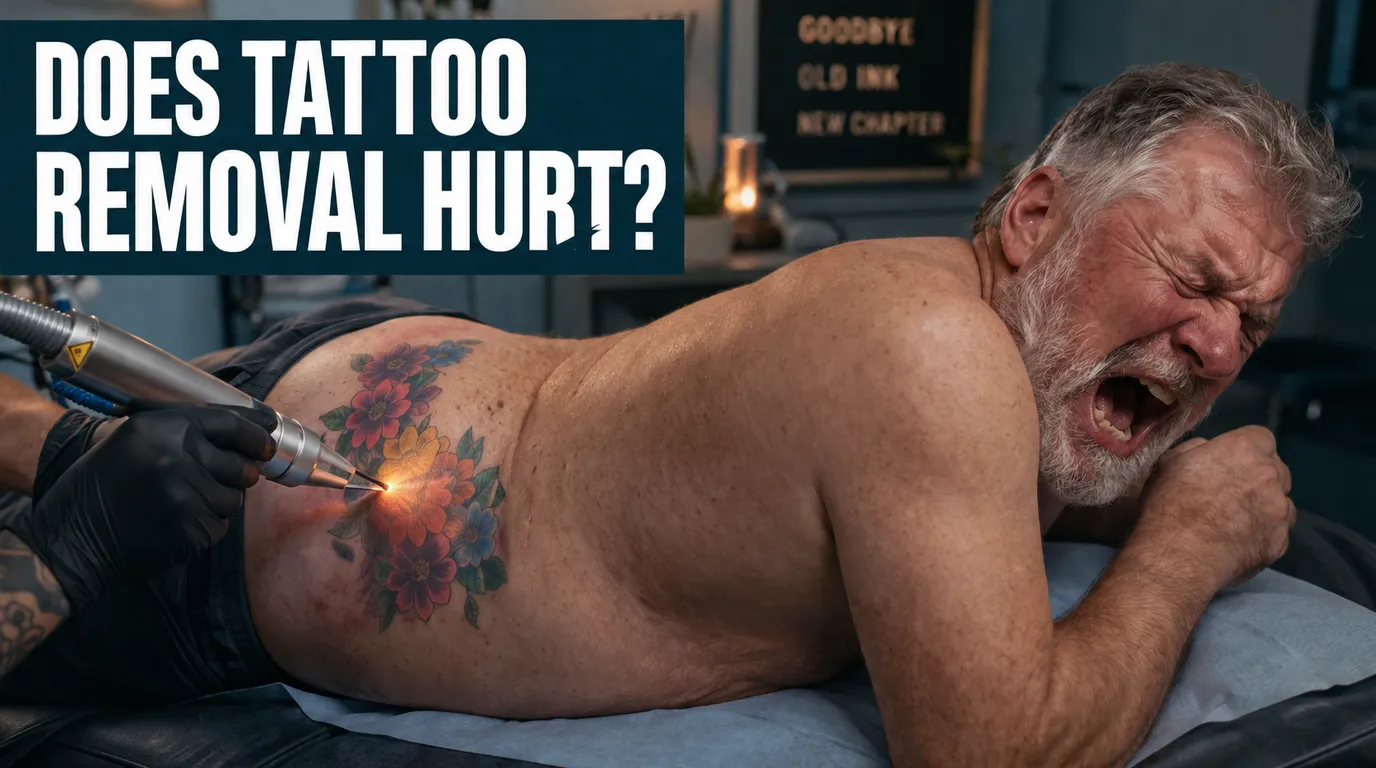
Most people compare the sensation to a rubber band snapping against the skin repeatedly, or say it hurts about the same as getting the tattoo in the first place. The laser session itself is fast, often under 10 minutes for a small tattoo, but the days that follow involve redness, swelling, and sometimes blistering as the immune response activates.
Clinics offer several options to manage the pain. Topical numbing creams containing lidocaine are typically applied 45-60 minutes before treatment. Cold air devices blow chilled air onto the skin during the procedure. For larger or more sensitive areas, some practitioners use local lidocaine injections or regional nerve blocks. The FDA has warned against using high-concentration lidocaine products not approved for over-the-counter use, as some topical pain products marketed for tattoo procedures contain dangerously high concentrations that can cause seizures or breathing problems when absorbed through large areas of treated skin.
The post-session experience is what catches most people off guard. Redness and swelling are nearly universal. Blistering occurs in a significant percentage of treatments and, while it looks alarming, is considered a normal tissue response rather than a complication. Crusting and scabbing follow as the blisters heal. According to the Cleveland Clinic, the treated area may also show temporary changes in skin color, either lightening (hypopigmentation) or darkening (hyperpigmentation), that can take weeks or months to resolve. Strict sun protection between sessions is critical because tanned or sun-exposed skin competes with the ink for laser absorption, increasing the risk of burns and pigmentation changes.
Will laser tattoo removal leave a scar?
The laser itself rarely causes scarring when operated at appropriate settings by an experienced practitioner. But many people discover that the original tattoo process created scar tissue they could not see beneath the ink, and the laser reveals it by removing the pigment that was masking it.
This distinction matters because it sets realistic expectations. The laser removes the ink. It does not remove scar tissue. If the tattoo artist used heavy hand pressure, went too deep, or the skin healed poorly after tattooing, a faint raised outline or textural change may remain visible after full ink clearance. That is not a complication of removal. It is a pre-existing condition that was hidden by pigment.
Actual laser-induced scarring is uncommon but not zero-risk. It is most likely when the fluence (energy level) is set too high, when sessions are spaced too closely together, or when the patient does not follow aftercare instructions. The risk is also higher for darker skin tones, where epidermal melanin absorbs some of the laser energy intended for the ink. The 1064nm Nd:YAG laser carries the lowest risk of pigmentation side effects in darker skin types because its longer wavelength bypasses melanin more effectively than shorter-wavelength systems. In one study comparing three Q-switched lasers, the ruby laser at 694nm produced hypopigmentation in 38% of treated areas, while the Nd:YAG at 1064nm produced 0%.
Can laser tattoo removal get rid of a tattoo completely?
For black ink on lighter skin, near-complete removal is a realistic outcome with enough sessions. For multicolor professional tattoos, the honest expectation is significant fading rather than skin that looks like it was never tattooed.
The 38% complete-removal figure from a 157-person post-treatment survey is the most frequently cited data point in clinical literature, and it reflects what most patients actually experience. The majority achieved substantial fading, with many reporting 75% or greater clearance, but residual pigment, a faint shadow or outline, or subtle textural differences persisted. These outcomes depend heavily on the variables discussed throughout this article: ink color, tattoo age, body location, skin tone, laser type, and the spacing and number of sessions.
It is worth noting that "removal" means different things in different contexts. A tattoo lightened to 50-70% clearance may look fully removed from normal conversational distance, even if close inspection reveals faint remnants. And many people pursuing removal are not seeking a blank canvas. They want the tattoo lightened enough for a cover-up, which typically requires only 3-5 sessions to reach the fading level most tattoo artists need to work over the existing design. If complete, invisible removal is the goal, expect to invest more sessions, more time, and more money than initial consultations may suggest.
Frequently Asked Questions
Can you get laser tattoo removal while pregnant or breastfeeding?
Laser tattoo removal is strictly not recommended during pregnancy or breastfeeding due to the potential risk of systemic heavy metal release and unstudied fetal exposure. As the laser shatters tattoo pigments, microscopic ink particles and heavy metals temporarily enter your blood and lymphatic system, which could theoretically pass through the placenta or into breast milk. You should wait until you have fully finished nursing before starting or resuming laser sessions.
Will laser tattoo removal permanently destroy hair follicles on my brows or body?
Standard tattoo removal lasers rarely destroy hair follicles permanently, though you may experience temporary hair bleaching or minor shedding in the treated area. Because tattoo lasers use ultra-short nanosecond or picosecond pulse durations, they target localized ink pigment rather than the sustained thermal energy required for permanent laser hair removal. Singed hair shaft pigment usually regrows normally within 1 to 2 hair growth cycles.
Do lymphatic drainage massages or detox supplements make tattoo ink clear faster?
There is no clinical evidence that commercial detox supplements speed up ink removal, though basic manual lymphatic drainage and proper hydration can support your body's natural immune clearing. While your lymphatic system handles the heavy lifting of filtering shattered pigment particles to the liver, over-the-counter "detox" products cannot boost macrophage phagocytosis rates. Focus on high water intake, consistent exercise, and checking your estimated timeline with our cost calculator.
Why did my white or cosmetic tattoo turn dark gray immediately after my laser session?
Immediate darkening occurs when titanium dioxide or iron oxide pigments undergo chemical oxidation from laser energy, turning flesh-toned or white ink into dark gray or black. This reaction (known as paradoxical darkening) is especially common with permanent makeup like microbladed eyebrows or lip liner and requires specialized laser protocols to resolve. If you need corrective removal for cosmetic ink, make sure to compare local clinics that specialize in permanent makeup before booking.
Does the light energy from tattoo removal lasers cause skin cancer?
No, tattoo removal lasers emit non-ionizing light energy and do not produce carcinogenic radiation or increase your risk of skin cancer. The light emitted by Q-switched and picosecond devices purely targets ink pigment through selective photothermolysis without mutating cellular DNA in surrounding skin tissue. However, technicians should always avoid firing laser light directly over pre-existing suspicious moles or skin lesions inside the tattoo zone.